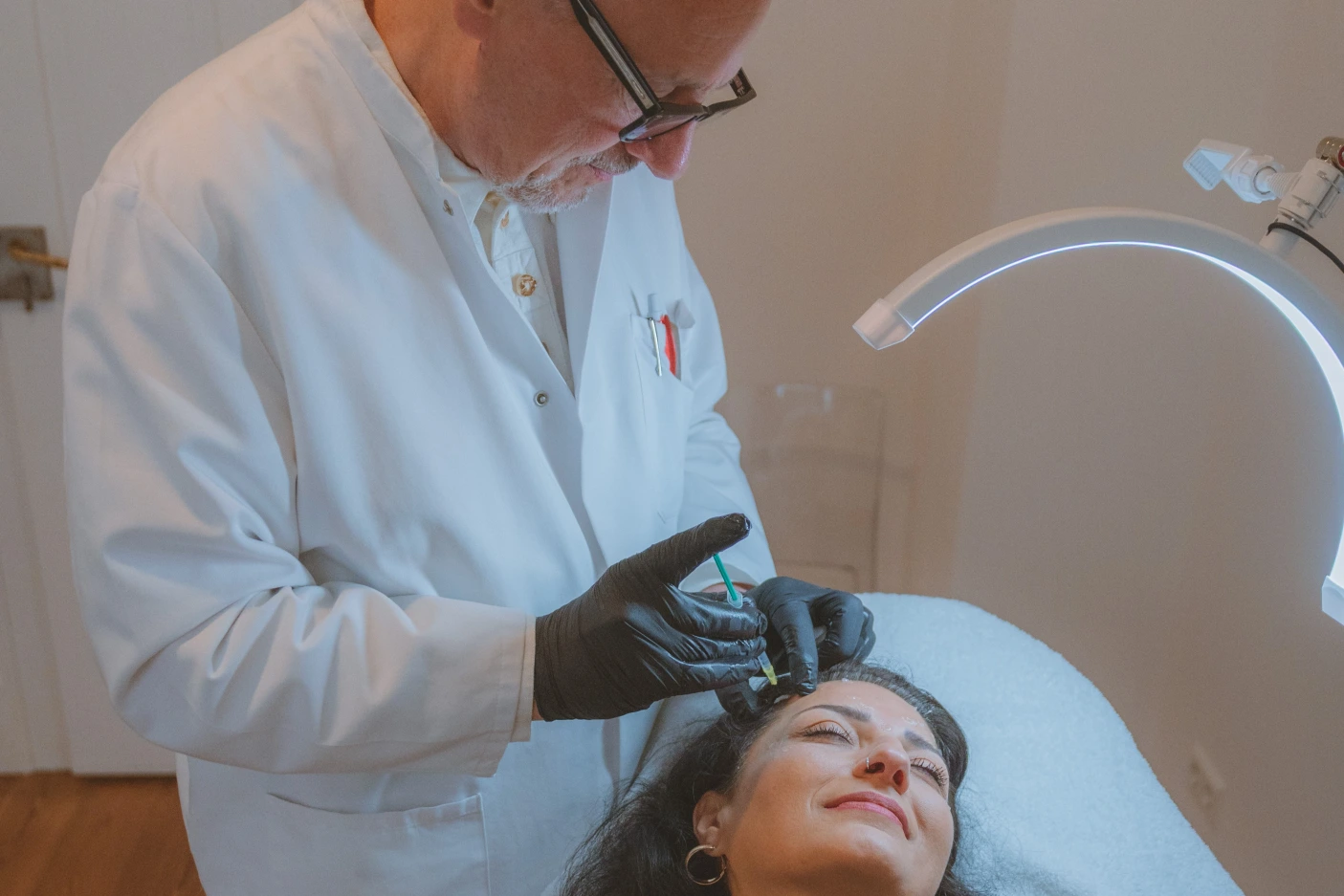


Facial expression, volume and skin quality raise different questions during a medical examination. This article explains the terms used in that discussion, the limitations of the procedures described and their risks. It is not a recommendation to choose a particular treatment.
You therefore do not need to choose a product before your appointment. A specific description is more helpful: are you bothered by a line when you smile, a change in your lip contour or fine creases on the surface of your skin? These observations raise different questions for the medical examination.
Facial expression, volume and skin quality are different concerns
A line that becomes more pronounced when you draw your eyebrows together is related to muscle activity. A change in facial contour, on the other hand, may involve the underlying tissue. Skin quality refers to features including hydration, elasticity and surface texture. Several changes can be present at the same time; this does not automatically mean that several treatments are needed. [1, 3, 4]
| Term | What it means | Where it plays a role |
|---|---|---|
| Botulinum toxin | An active medicinal substance | Temporary reduction of certain muscle activity |
| Hyaluronic acid filler | An injectable gel from a group of filling materials | Volume and contours; depending on the product, also certain wrinkles |
| Polynucleotides | Processed chains of nucleic acid building blocks | An approach being studied to improve certain aspects of skin quality |
This overview is for orientation. It cannot be used as a self-test to determine which procedure is suitable for you.
Botulinum toxin: how the substance relates to facial expression
Botulinum toxin type A is a prescription-only substance. It temporarily inhibits the release of the messenger acetylcholine at the nerve endings that activate a muscle. As a result, the treated muscle contracts less strongly. The substance does not fill a wrinkle or replace lost volume. [1]
In aesthetic medicine, it is used for certain facial expression lines, for example between the eyebrows, on the forehead or beside the eyes. Which uses are authorised, and under what conditions, depends on the specific medicine. Use outside its authorisation is known as off-label use and requires a separate medical assessment. [1]
The effect is not immediate. It develops in the days after treatment and often lasts around three to four months. This is a guide, not a promise for an individual case. How noticeably facial expression changes depends on factors including the treatment area, dosage and initial findings. [2]
Possible side effects include bruising, headaches, asymmetries or temporary weakness of neighbouring muscles, for example resulting in a drooping eyelid. Rare severe symptoms such as difficulty swallowing, speaking or breathing require immediate medical assessment. [1, 2]
Hyaluronic acid and fillers: why the terms do not mean the same thing
Hyaluronic acid occurs naturally in the body and binds water. For injections, it is used as a processed gel. Properties such as cross-linking and firmness influence how a product behaves in the tissue. This is different from hyaluronic acid in a skincare cream. [3]
Filler is the umbrella term for injectable filling materials. A hyaluronic acid filler is one type; not every filler consists of hyaluronic acid. These gels may be used, for example, for selected volume deficits in the cheeks or lips and for certain contour changes. Which material may be appropriate in which area requires an individual assessment. [3]
An initial increase in volume may be visible early on. Immediately after treatment, however, swelling affects the appearance. How long the effect lasts also varies between products and areas. A quantity in millilitres describes the amount of material, not the result that can be achieved. [3, 5]
Polynucleotides: what the long name means
Polynucleotides, or PN, consist of many connected nucleotides. These are the building blocks of nucleic acids such as DNA. Aesthetic products use processed DNA fragments, often derived from fish tissue. No living stem cells are injected. The origin and composition of the specific product should be discussed during informed consent, particularly if you have known allergies. [6]
PN products are mainly being studied in relation to skin hydration, elasticity, fine lines and skin texture. They are neither an equivalent substitute for targeted muscle treatment nor automatically a means of creating substantial volume. Terms such as “regeneration” alone say little about what visible change a particular person can expect. [6]
What the studies actually show
A small randomised study involving 27 people compared polynucleotides with non-cross-linked hyaluronic acid in the eye area. The two sides of the face were treated with different products. Some measurements improved in favour of the polynucleotides. Such a comparison provides indications, but does not establish the long-term effects of every available PN product or how it behaves in other facial areas. [7]
A 2025 systematic review included nine studies involving a total of 219 people and rated their quality as low to moderate. The results so far therefore do not demonstrate that “skin renewal” will reliably occur. Treatment plans, products and the areas studied differ; robust conclusions about optimal use and long-term safety remain limited. [6]
And what is a skinbooster?
“Skinbooster” does not refer to a single medicine or a standard formulation. The term often describes injection treatments intended to improve skin hydration or surface texture. Certain hyaluronic acid gels may be used for this purpose. The aim differs from building pronounced contours, even though both may involve hyaluronic acid.
There are controlled studies for individual products, for example on skin smoothness and fine lines on the cheeks. These findings initially apply to the product and procedure studied. They cannot be generalised to everything described as a skinbooster. [4]
Ask about the specific product and intended goal. The answer “for skin quality” should become more precise during the conversation: does it mean hydration, surface texture or another clearly described change?
Hyaluronidase: a term used in correction
Hyaluronidase is an enzyme that breaks down hyaluronic acid. In aesthetic medicine, it may be used when a hyaluronic acid filler is to be dissolved for medical or aesthetic reasons. It can also form part of emergency medical treatment for certain filler complications. Other filling materials cannot simply be removed with it. [8]
This does not make it a reliable “undo button”. The outcome depends on factors including the material and the findings; the treatment has its own risks, including allergic reactions. Not every uneven area needs to be dissolved. The first step is to establish whether the cause is, for example, swelling, an inflammatory reaction or an unwanted deposit of filler. [5, 8]
Exosomes are not polynucleotides
Exosomes are tiny vesicles released by cells: particles enclosed by a membrane. They can carry proteins and nucleic acids, among other substances, and play a role in communication between cells. This biological mechanism does not, however, demonstrate that a marketed product visibly and safely improves the skin. [9]
For products containing exosomes, the origin, processing, route of administration and clinical evidence must be examined specifically. Being intended for application to the skin does not make a product suitable for injection. In 2019, the US Food and Drug Administration (FDA) warned about serious adverse events following unapproved products marketed as containing exosomes. This is not a blanket judgement on whether a product is permitted in Germany, but underlines the need to examine each product individually. [10]
For information about a medical consultation at Bodywise, see our page on exosome injections in Heidelberg.
Which risks should be discussed before making a decision?
Redness, swelling or bruising may occur after injections. Other risks vary according to the material and treatment area. With fillers, possible complications include infections, lumps and delayed inflammatory reactions. A rare, particularly serious complication is a blocked blood vessel with possible tissue damage; vision loss has also been reported. [3, 5]
How to prepare for your first appointment
Describe the change you would like and what you do not want. For example: “The line bothers me at rest, but I want my facial expression to remain recognisable.” This is more helpful than a product name or an edited comparison photograph.
Bring a list of your medicines and supplements, along with any existing treatment records. Tell the doctor about allergies, medical conditions, previous procedures and products used. Do not stop prescribed medicines, particularly blood thinners, on your own. Pregnancy, breastfeeding and acute infections should also be discussed; depending on the procedure, treatment may not be suitable in these circumstances. [1, 11]
The examination assesses the face and facial expressions, asymmetries, skin and tissue. These findings determine whether a procedure is suitable. Waiting, further diagnostic assessment or choosing not to have a procedure may also be appropriate.
You can find specific questions for the discussion in our article Aesthetic consultation: Which questions matter beforehand?
Clarify costs and aftercare beforehand
Prices can only be compared once it is clear what they refer to: consultation, quantity of material or a defined treatment scope. A price “from” a certain amount does not yet establish binding total costs. Also clarify which follow-up appointments are included and what additional costs may arise.
Published information is available in the Bodywise price and service overview. Ask in advance about the cost of a consultation solely about aesthetics; the price of a general medical consultation does not automatically apply to it.
Discuss expected reactions, when the results will be reviewed and aftercare. Allow sufficient time before important events for possible swelling or bruising. Ask how to reach the practice if you experience symptoms.
Questions for a medical consultation
Dr Michael Pees offers medical examination and consultation at Bodywise. The discussion covers your concerns, previous treatments, medicines and any need for further assessment. You can request a consultation and clarify its scope and fee beforehand. This enquiry does not select a product or book a treatment.
This article explains medical terms and does not replace an individual examination or an informed consent discussion.
Medical sources and further information
Research current as of 8 September 2026. Product information explains the particular product; it does not mean that Bodywise uses that brand. US information on authorisations does not apply to Germany.
- AbbVie: VISTABEL prescribing information, January 2024.
Mechanism of action, authorised uses, contraindications and warnings.
https://www.fachinfo.de/fi/pdf/009611/vistabel-r-4-allergan-einheiten-0-1-ml-pulver-zur-herstellung-einer-injektionsloesung - American Academy of Dermatology: Botulinum toxin therapy – FAQs.
General course, duration of effect and possible side effects.
https://www.aad.org/public/cosmetic/wrinkles/botulinum-toxin-faqs - U.S. Food and Drug Administration: Dermal Fillers (Soft Tissue Fillers).
Groups of materials, examples of uses and complications. US authorisations do not apply to Germany.
https://www.fda.gov/medical-devices/aesthetic-cosmetic-devices/dermal-fillers-soft-tissue-fillers - Alexiades M et al. Dermatologic Surgery. 2023;49(7):682–688.
Randomised study of a specific hyaluronic acid gel and skin quality. DOI: 10.1097/DSS.0000000000003802. Manufacturer-funded study.
https://pmc.ncbi.nlm.nih.gov/articles/PMC10292578/ - U.S. Food and Drug Administration: Dermal Filler Do’s and Don’ts for Wrinkles, Lips and More.
Informed consent, expected reactions and serious vascular complications.
https://www.fda.gov/consumers/consumer-updates/dermal-filler-dos-and-donts-wrinkles-lips-and-more - Lampridou S et al. Journal of Cosmetic Dermatology. 2025;24(2):e16721.
The Effectiveness of Polynucleotides in Esthetic Medicine: A Systematic Review. DOI: 10.1111/jocd.16721. Some authors disclose industry connections.
https://pmc.ncbi.nlm.nih.gov/articles/PMC11845969/ - Lee YJ et al. Journal of Dermatological Treatment. 2022;33(1):254–260.
Randomised split-face study of PN and hyaluronic acid in the eye area; published online in 2020. DOI: 10.1080/09546634.2020.1748857.
https://pubmed.ncbi.nlm.nih.gov/32248707/ - Murray G et al. Journal of Clinical and Aesthetic Dermatology. 2021;14(8):E69–E75.
Guideline for the Safe Use of Hyaluronidase in Aesthetic Medicine, Including Modified High-dose Protocol.
https://pubmed.ncbi.nlm.nih.gov/34840662/ - Mahmoud RH et al. Journal of Clinical and Aesthetic Dermatology. 2025;18(4):33–40.
Exosomes: A Comprehensive Review for the Practicing Dermatologist.
https://pubmed.ncbi.nlm.nih.gov/40256340/ - U.S. Food and Drug Administration: Public Safety Notification on Exosome Products, 6 December 2019.
Safety warning about unapproved products in the USA; not a statement about a specific Bodywise product.
https://www.fda.gov/vaccines-blood-biologics/safety-availability-biologics/public-safety-notification-exosome-products - American Academy of Dermatology: Botulinum toxin therapy – Preparation.
Pre-existing conditions, medicines and preparation for the medical consultation.
https://www.aad.org/public/cosmetic/wrinkles/botulinum-toxin-preparation